EMDR stands for Eye Movement Desensitisation Reprocessing. It is a psychotherapy treatment that has been extensively researched and proven effective to help millions of adults, young people and children recover from both PTSD and C-PTSD and the problems they cause, like flashbacks, upsetting thoughts or images, hypervigilance and other symptoms.
EMDR uses eye movements and sometimes audio tones, or even small hand-held buzzers to repeatedly stimulate the left and ride sides (hemispheres) of your brain to properly process traumatic intense and debilitating memories into simply memories.
EMDR for children
Younger children can find it difficult to fully engage with some types of talking therapies, so EMDR can be an effective, simpler alternative. EMDR also has the highest recommendation for Children and Adolescents with PTSD from the International Society for Traumatic Stress Studies (ISTSS, 2018).
The therapy sessions can be adapted ‘depending upon the specific needs and developmental stage of your child or adolescent. For example, pictures may be used instead of words or the therapist may write a story or narrative about the traumatic events to make the therapy more accessible to children who are struggling to talk about the trauma.’
One study with children aged 8-18 who had developed PTSD after a single traumatic event showed that almost 92% of children no longer had PTSD after around four sessions of EMDR. They were still free of PTSD one year later.
What does EMDR for children involve?
‘EMDR involves asking the child to think about the upsetting events after which he or she is asked to look at the therapist’s finger and follow it back and forth for about 15 to 30 seconds. Other types of left-right stimulation such as hand taps or drumming might be used if a child finds the eye movements difficult. After a few seconds of eye movements or other right-left stimulation, the therapist stops, asks the child to take a deep breath, let go of the image, and rest. The therapist then asks the child what comes up next in his or her mind. Typically something shifts and the child reports a new image, thought, feeling, or physical sensation. Then the child is asked to hold this in mind and follow another set of eye movements, hand taps or sounds. Sometimes upsetting thoughts and feelings come up and need to be dealt with. The procedure continues (unless the child gives the STOP signal) until the event no longer seems upsetting for the child.’
Finding an EMDR therapist for your child
It is really important to find a suitable child EMDR therapist who has been specially trained to work with children who can build a good therapeutic relationship with both you and your child. Please ensure that the therapist has attended an accredited training in EMDR (as recognised by the EMDR UK Association) and has also completed further accredited training to use EMDR with children and adolescents.
Many NHS services within the UK, Ireland, Scotland and Wales offer EMDR within CAMHS teams for children and adolescents. There are also private or independent EMDR therapists or practitioners throughout the United Kingdom and Ireland and the EMDR Association website can help you to locate suitable accredited therapists in your area.’
Here is a useful animation to explain EMDR to children, adolescents and their carers from the EMDR Association:
Social MEDIA SHARE THIS PAGE
- EMDR Institute
- EMDR Association
- Universiteit van Amsterdam (UVA). (2017, June 29). PTSD in children quickly and effectively treatable within hours. ScienceDaily. Retrieved February 23, 2021 from www.sciencedaily.com/releases/2017/06/170629085311.htm
- Carletto Sara, Borghi Martina, Bertino Gabriella, Oliva Francesco, Cavallo Marco, Hofmann Arne, Zennaro Alessandro, Malucchi Simona, Ostacoli LucaTreating Post-traumatic Stress Disorder in Patients with Multiple Sclerosis: A Randomized Controlled Trial Comparing the Efficacy of Eye Movement Desensitization and Reprocessing and Relaxation Therapy Frontiers in Psychology VOL. 7 2016 Page 526 https://www.frontiersin.org/article/10.3389/fpsyg.2016.00526 DOI10.3389/fpsyg.2016.00526
- Chen L, Zhang G, Hu M, Liang X. Eye movement desensitization and reprocessing versus cognitive-behavioral therapy for adult posttraumatic stress disorder: systematic review and meta-analysis. J Nerv Ment Dis. 2015 Jun;203(6):443-51. doi: 10.1097/NMD.0000000000000306. PMID: 25974059.
- Chen Y-R, Hung K-W, Tsai J-C, Chu H, Chung M-H, Chen S-R, et al. (2014) Efficacy of Eye-Movement Desensitization and Reprocessing for Patients with Posttraumatic-Stress Disorder: A Meta-Analysis of Randomized Controlled Trials. PLoS ONE 9(8): e103676. https://doi.org/10.1371/journal.pone.0103676
- Bisson, J., Roberts, N.P., Andrew, M., Cooper, R. & Lewis, C. (2013). Psychological therapies for chronic post-traumatic stress disorder (PTSD) in adults (Review). Cochrane Database of Systematic Reviews 2013, DOI: 10.1002/14651858.CD003388.pub4
- Bradley, R., Greene, J., Russ, E., Dutra, L., & Westen, D. (2005).A multidimensional meta-analysis of psychotherapy for PTSD. American Journal of Psychiatry, 162, 214-227.
- Lee, C.W., & Cuijpers, P. (2013). A meta-analysis of the contribution of eye movements in processing emotional memories. Journal of Behavior Therapy & Experimental Psychiatry, 44, 231-23
- Seidler, G.H., & Wagner, F.E. (2006). Comparing the efficacy of EMDR and trauma-focused cognitive-behavioral therapy in the treatment of PTSD: a meta-analytic study. Psychological Medicine, 36,1515-1522.
- Acarturk, C., Konuk, E., Cetinkaya, M., Senay, I., Sijbrandij, M., Gulen, B., & Cuijpers, P. (2016). The efficacy of eye movement desensitization and reprocessing for post-traumatic stress disorder and depression among Syrian refugees: Results of a randomized controlled trial. Psychological medicine, 46(12), 2583-2593
- Raymond W. Gunter, Glen E. Bodner, How eye movements affect unpleasant memories: Support for a working-memory account, Behaviour Research and Therapy, Volume 46, Issue 8, 2008, Pages 913-931, ISSN 0005-7967,https://doi.org/10.1016/j.brat.2008.04.006.
- Comparison of two treatments for traumatic stress: A community-based study of EMDR and prolonged exposure, Ironson, B. Freund, J. L. Strauss, J. Williams
- Scheck MM, Schaeffer JA, Gillette C. Brief psychological intervention with traumatized young women: the efficacy of eye movement desensitization and reprocessing. J Trauma Stress. 1998 Jan;11(1):25-44. doi: 10.1023/A:1024400931106. PMID: 9479674.
-
PTSD in children quickly and effectively treatable within hours
- EMDR Therapy for Anxiety, Panic, PTSD and Trauma
- EMDR Therapy: Breaking Down the Barriers
- EMDR International Association
- American Psychological Association
-
Here’s What You Need To Know Before Your First EMDR Therapy Session
Info goes here
Join us in supporting the journey toward healing and recovery for everyone with PTSD & C-PTSD
Help us provide vital support, information, and resources across the UK
Printed Support Items
Our Supporters store offers a variety of merchandise to help raise awareness, along with practical items to support your treatment and recovery like our Ink and Insight Toolkit, Emotional Wheel Postcards, PTSD & C-PTSD Symptom Tracker sheets, Safety Plan worksheets and Communication Cards.

Insights: The PTSD UK Blog
Your Source for the Latest Support and Advice

AAA STANDARD BLOG POST
Lorem ipsum dolor sit amet, consectetur adipiscing elit. Donec tortor tortor, facilisis eu imperdiet sit amet, semper eget urna. Quisque sit amet erat risus. Pellentesque habitant morbi tristique senectus et netus et malesuada fames ac turpis egestas.
Read article
Why does Post Traumatic Stress Disorder make you so tired?
Lorem ipsum dolor sit amet, consectetur adipiscing elit. Donec tortor tortor, facilisis eu imperdiet sit amet, semper eget urna. Quisque sit amet erat risus. Pellentesque habitant morbi tristique senectus et netus et malesuada fames ac turpis egestas.
Read article
Hello world!
Lorem ipsum dolor sit amet, consectetur adipiscing elit. Donec tortor tortor, facilisis eu imperdiet sit amet, semper eget urna. Quisque sit amet erat risus. Pellentesque habitant morbi tristique senectus et netus et malesuada fames ac turpis egestas.
Read article
Hello world!
Lorem ipsum dolor sit amet, consectetur adipiscing elit. Donec tortor tortor, facilisis eu imperdiet sit amet, semper eget urna. Quisque sit amet erat risus. Pellentesque habitant morbi tristique senectus et netus et malesuada fames ac turpis egestas.
Read article
Hello world!
Lorem ipsum dolor sit amet, consectetur adipiscing elit. Donec tortor tortor, facilisis eu imperdiet sit amet, semper eget urna. Quisque sit amet erat risus. Pellentesque habitant morbi tristique senectus et netus et malesuada fames ac turpis egestas.
Read articleSign up to be a 'Friend of PTSD UK' today!
Unlock exclusive resources, discounts and events: just £5 per month
PTSD UK Impact Report 2025
Our Impact Report shines a light on the real-world difference PTSD UK is making for people affected by PTSD and C-PTSD across the country. Whether it’s helping someone access life-changing therapy, offering trusted information at a critical moment, or raising awareness that leads to understanding — your support is at the heart of it all.
If you’d like to see exactly how we’re turning compassion into action, and hope into healing, take a look at our latest Impact Report.

Practical Tools & Guidance
Resources & downloads for practical and tangible support
STANDARD PAGE TEMPLATECreate Your Own Fundraiser: Make a Difference Your Way
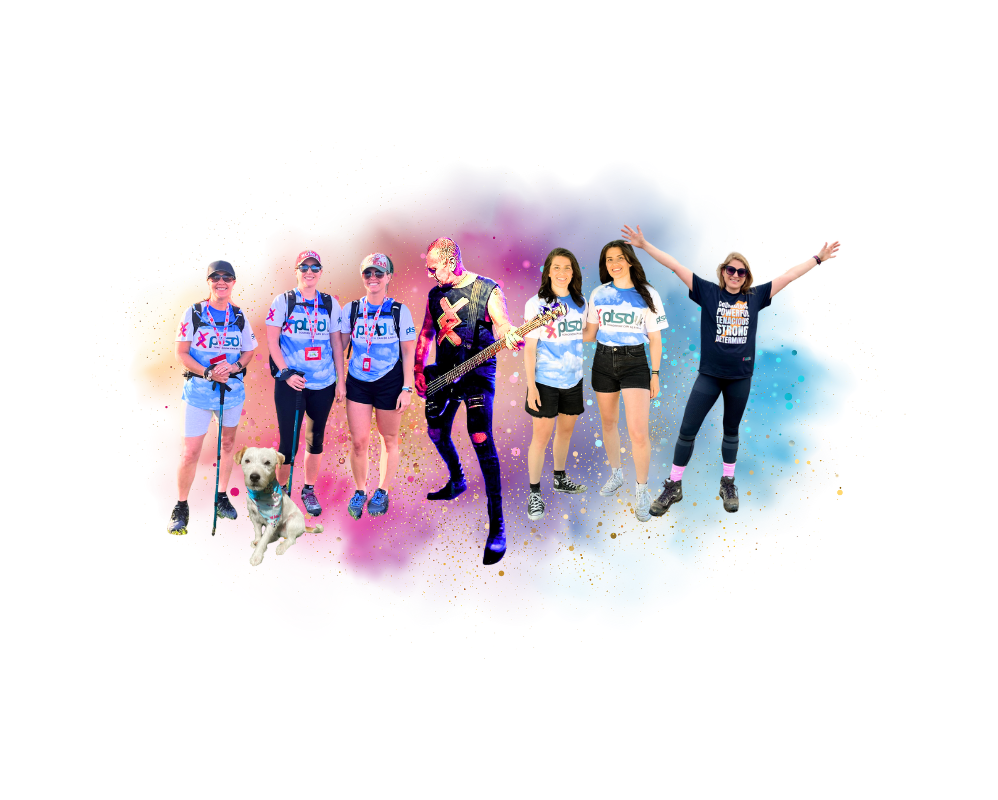
Whether it’s hosting a band night, swimming lengths for sponsorship, taking your dog on a fundraising walk, a sponsored leg wax or head shave, or hiking up Ben Nevis – the choice is yours! Every fundraiser helps us reach more people affected by PTSD & C-PTSD to help change lives.

Find us on Facebook
Join us on Facebook for the latest news, updates, personal stories, helpful articles, and community support. It’s a great place to stay connected and see how your support is making a difference.
Join the Conversation
Find us on Instagram
Follow us on Instagram for powerful quotes, uplifting messages, behind-the-scenes updates, and visual resources designed to support and inspire anyone affected by PTSD or C-PTSD.
Find Daily Inspiration
Find us on TikTok
Catch us on TikTok for quick, engaging videos that raise awareness, share real experiences, and highlight the small steps that can lead to big changes in PTSD and C-PTSD recovery.
Watch & LearnNewsletter sign up to go here