Information Gathering
Before any EMDR therapy begins, your therapist will do an in-depth assessment to help guide your work together and to develop your treatment plan. They’ll spend one or two sessions discussing your history, and they’ll talk about your life and relationships. You’ll then look to discuss ‘possible targets for EMDR processing. These include recent distressing events, current situations that elicit emotional disturbance, related historical incidents, and the development of specific skills and behaviours that will be needed by the client in future situations.’
You’ll also talk about how EMDR works, and may discuss at this stage if you’d prefer to use a light bar, the therapists fingers or even tapping or music to induce the left to right eye movements during the later sessions.
Setting a Safe Place
The next sessions are designed to help you feel calm and balanced, ensure that you’re capable of handling emotional stress, understand your capacity to ‘disassociate’ – and help you find your ‘safe place’ and good coping mechanisms. If further ‘stabilisation’ is required, or if additional skills are needed, you’ll work together until you can find these. During these sessions, your therapist will get you used to the left/right eye movements initially combined with calming imagery and thoughts.
Your ‘Safe place’ (also called Peaceful Place, Happy Place, or Calm Place) can be thought of as an ‘emotional sanctuary where a person can internally go to recover stability when feeling stressed’. The main purpose of the Safe Place is to teach and demonstrate that you can ‘move from distressed to calm (make a state change) within a short period of time. This is a key skill needed for emotion regulation and healthy self-soothing but also a requirement before processing of traumatic events’. It can be an imaginary place, or a place where you feel safe and secure (ideally not linked to any past traumatic experiences or people who were part of these).
Our founder, Jacqui said of her ‘safe place’: “For me and my overactive hypervigilant mind, nowhere was safe to me, so I developed an imaginary tropical beach with all my friends forming a human chain around me to keep me safe, my cat jumping around and my husband making me laugh. I could use this ‘space’ anytime I needed to during a session, or even at home in the midst of a panic attack. I would concentrate on the beach, on each persons face, or what they would say to me, and get involved in that moment which would calm me down when I needed to.
If at any point during the forthcoming sessions, things got too much or I had a non-controlled flashback, I went back to that safe place in my mind. I know that some people use this ‘space’ during EMDR a fair bit, and it all depends on the individual, but luckily I only ever needed to visit my safe place a few times.”
Having this ‘safe place’ and the stress reducing techniques established means that you can go there whenever you need to – during or between sessions.
Processing Memories
When ready for the next phases of EMDR therapy, you will be asked to focus on a specific event, thought, image or memory. You will identify the most vivid visual image related to the trauma (if available), a negative belief about yourself, related emotions and body sensations. While you do this, your therapist will reintroduce the same kind of gentle, rhythmic eye movements that you used before. They will move his or her fingers back and forth in front of your face and ask you to follow these hand motions with your eyes.
Gradually, the therapist will guide you to shift your thoughts to more pleasant ones. You’ll think of a ‘preferred positive belief (for example ‘I am strong and in control of this situation’).
Throughout the process, you are awake, alert and in control at all times. No trance state is induced, no suggestions are made, and the changes that occur are the result of the client’s own natural brain functions.
You’ll do this in sets of a few minutes at a time. Each with a break in between where your therapist will check in with you. You’ll be guided to notice what comes to mind after each set. Depending on what you noticed, you’ll be guided to the next focus of attention from that thought. This is repeated throughout the session. When you feel no distress in relation to that memory, you focus on the positive, preferred belief, whilst still doing the eye movements. ‘After several sets, clients generally report increased confidence in this positive belief. The therapist checks with the client regarding body sensations. If there are negative sensations, these are processed as above. If there are positive sensations, they are further enhanced.’
During this time, you have full control to stop the therapist at any point if needed, but you’ll continue until the event becomes less disturbing. ‘The inappropriate emotions, beliefs, and body sensations will be discarded. Negative emotions, feelings and behaviours are generally caused by unresolved earlier experiences that are pushing you in the wrong directions. The goal of EMDR therapy is to leave you with the emotions, understanding, and perspectives that will lead to healthy and useful behaviours and interactions.’
Closure and Re-evaluation
In your final sessions, you may be asked to keep a journal in between sessions. This is just so you can discuss anything that came up throughout the week with your therapist, and to remind yourself that the self-calming activities were working.
At this stage, you’ll likely discuss your memories that have been processed to ensure they don’t elicit any distress, and discuss future scenarios, and how you might handle them.
‘After EMDR processing, clients generally report that the emotional distress related to the memory has been eliminated, or greatly decreased, and that they have gained important cognitive insights.’ There may also be a strong sense of relief, a feeling of openness or simply just a relaxed contentment with the world – a feeling that many people with PTSD have missed greatly.
Please remember, these are not medical recommendations. Be sure to work with a professional to find the best methods for you. EMDR should always be delivered by properly trained therapists.
Social MEDIA SHARE THIS PAGE
- EMDR Institute
- EMDR Association
- Universiteit van Amsterdam (UVA). (2017, June 29). PTSD in children quickly and effectively treatable within hours. ScienceDaily. Retrieved February 23, 2021 from www.sciencedaily.com/releases/2017/06/170629085311.htm
- Carletto Sara, Borghi Martina, Bertino Gabriella, Oliva Francesco, Cavallo Marco, Hofmann Arne, Zennaro Alessandro, Malucchi Simona, Ostacoli LucaTreating Post-traumatic Stress Disorder in Patients with Multiple Sclerosis: A Randomized Controlled Trial Comparing the Efficacy of Eye Movement Desensitization and Reprocessing and Relaxation Therapy Frontiers in Psychology VOL. 7 2016 Page 526 https://www.frontiersin.org/article/10.3389/fpsyg.2016.00526 DOI10.3389/fpsyg.2016.00526
- Chen L, Zhang G, Hu M, Liang X. Eye movement desensitization and reprocessing versus cognitive-behavioral therapy for adult posttraumatic stress disorder: systematic review and meta-analysis. J Nerv Ment Dis. 2015 Jun;203(6):443-51. doi: 10.1097/NMD.0000000000000306. PMID: 25974059.
- Chen Y-R, Hung K-W, Tsai J-C, Chu H, Chung M-H, Chen S-R, et al. (2014) Efficacy of Eye-Movement Desensitization and Reprocessing for Patients with Posttraumatic-Stress Disorder: A Meta-Analysis of Randomized Controlled Trials. PLoS ONE 9(8): e103676. https://doi.org/10.1371/journal.pone.0103676
- Bisson, J., Roberts, N.P., Andrew, M., Cooper, R. & Lewis, C. (2013). Psychological therapies for chronic post-traumatic stress disorder (PTSD) in adults (Review). Cochrane Database of Systematic Reviews 2013, DOI: 10.1002/14651858.CD003388.pub4
- Bradley, R., Greene, J., Russ, E., Dutra, L., & Westen, D. (2005).A multidimensional meta-analysis of psychotherapy for PTSD. American Journal of Psychiatry, 162, 214-227.
- Lee, C.W., & Cuijpers, P. (2013). A meta-analysis of the contribution of eye movements in processing emotional memories. Journal of Behavior Therapy & Experimental Psychiatry, 44, 231-23
- Seidler, G.H., & Wagner, F.E. (2006). Comparing the efficacy of EMDR and trauma-focused cognitive-behavioral therapy in the treatment of PTSD: a meta-analytic study. Psychological Medicine, 36,1515-1522.
- Acarturk, C., Konuk, E., Cetinkaya, M., Senay, I., Sijbrandij, M., Gulen, B., & Cuijpers, P. (2016). The efficacy of eye movement desensitization and reprocessing for post-traumatic stress disorder and depression among Syrian refugees: Results of a randomized controlled trial. Psychological medicine, 46(12), 2583-2593
- Raymond W. Gunter, Glen E. Bodner, How eye movements affect unpleasant memories: Support for a working-memory account, Behaviour Research and Therapy, Volume 46, Issue 8, 2008, Pages 913-931, ISSN 0005-7967,https://doi.org/10.1016/j.brat.2008.04.006.
- Comparison of two treatments for traumatic stress: A community-based study of EMDR and prolonged exposure, Ironson, B. Freund, J. L. Strauss, J. Williams
- Scheck MM, Schaeffer JA, Gillette C. Brief psychological intervention with traumatized young women: the efficacy of eye movement desensitization and reprocessing. J Trauma Stress. 1998 Jan;11(1):25-44. doi: 10.1023/A:1024400931106. PMID: 9479674.
-
PTSD in children quickly and effectively treatable within hours
- EMDR Therapy for Anxiety, Panic, PTSD and Trauma
- EMDR Therapy: Breaking Down the Barriers
- EMDR International Association
- American Psychological Association
-
Here’s What You Need To Know Before Your First EMDR Therapy Session
Info goes here
Join us in supporting the journey toward healing and recovery for everyone with PTSD & C-PTSD
Help us provide vital support, information, and resources across the UK
Printed Support Items
Our Supporters store offers a variety of merchandise to help raise awareness, along with practical items to support your treatment and recovery like our Ink and Insight Toolkit, Emotional Wheel Postcards, PTSD & C-PTSD Symptom Tracker sheets, Safety Plan worksheets and Communication Cards.

Insights: The PTSD UK Blog
Your Source for the Latest Support and Advice

AAA STANDARD BLOG POST
Lorem ipsum dolor sit amet, consectetur adipiscing elit. Donec tortor tortor, facilisis eu imperdiet sit amet, semper eget urna. Quisque sit amet erat risus. Pellentesque habitant morbi tristique senectus et netus et malesuada fames ac turpis egestas.
Read article
Why does Post Traumatic Stress Disorder make you so tired?
Lorem ipsum dolor sit amet, consectetur adipiscing elit. Donec tortor tortor, facilisis eu imperdiet sit amet, semper eget urna. Quisque sit amet erat risus. Pellentesque habitant morbi tristique senectus et netus et malesuada fames ac turpis egestas.
Read article
Hello world!
Lorem ipsum dolor sit amet, consectetur adipiscing elit. Donec tortor tortor, facilisis eu imperdiet sit amet, semper eget urna. Quisque sit amet erat risus. Pellentesque habitant morbi tristique senectus et netus et malesuada fames ac turpis egestas.
Read article
Hello world!
Lorem ipsum dolor sit amet, consectetur adipiscing elit. Donec tortor tortor, facilisis eu imperdiet sit amet, semper eget urna. Quisque sit amet erat risus. Pellentesque habitant morbi tristique senectus et netus et malesuada fames ac turpis egestas.
Read article
Hello world!
Lorem ipsum dolor sit amet, consectetur adipiscing elit. Donec tortor tortor, facilisis eu imperdiet sit amet, semper eget urna. Quisque sit amet erat risus. Pellentesque habitant morbi tristique senectus et netus et malesuada fames ac turpis egestas.
Read articleSign up to be a 'Friend of PTSD UK' today!
Unlock exclusive resources, discounts and events: just £5 per month
PTSD UK Impact Report 2025
Our Impact Report shines a light on the real-world difference PTSD UK is making for people affected by PTSD and C-PTSD across the country. Whether it’s helping someone access life-changing therapy, offering trusted information at a critical moment, or raising awareness that leads to understanding — your support is at the heart of it all.
If you’d like to see exactly how we’re turning compassion into action, and hope into healing, take a look at our latest Impact Report.

Practical Tools & Guidance
Resources & downloads for practical and tangible support
STANDARD PAGE TEMPLATECreate Your Own Fundraiser: Make a Difference Your Way
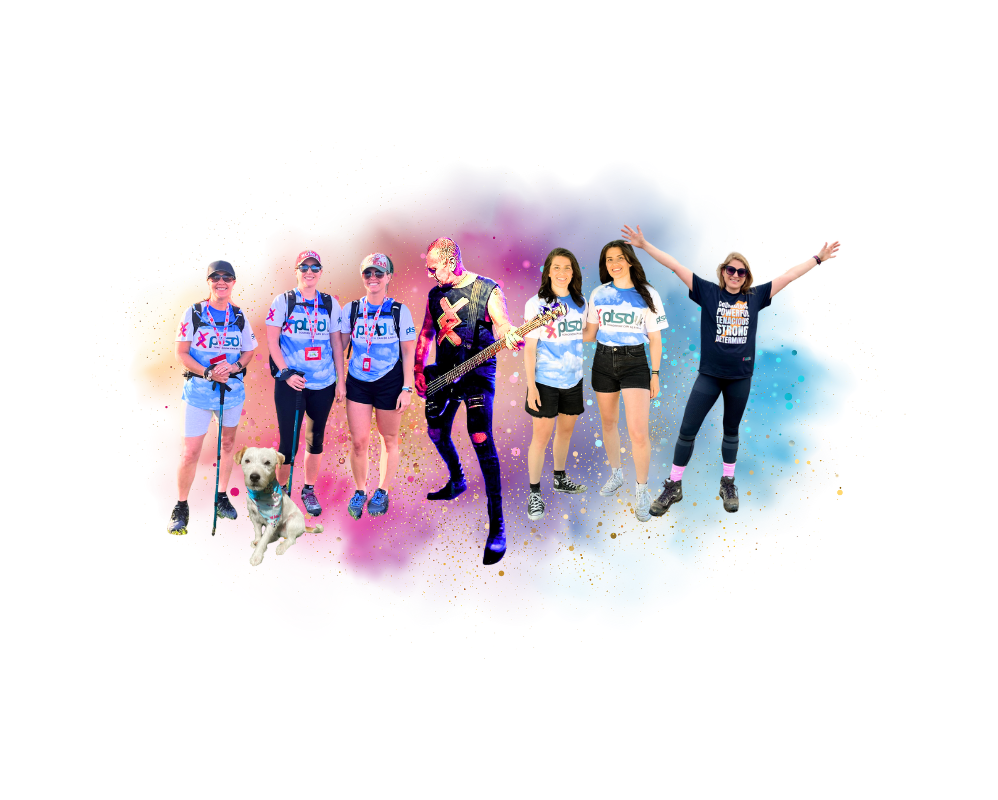
Whether it’s hosting a band night, swimming lengths for sponsorship, taking your dog on a fundraising walk, a sponsored leg wax or head shave, or hiking up Ben Nevis – the choice is yours! Every fundraiser helps us reach more people affected by PTSD & C-PTSD to help change lives.

Find us on Facebook
Join us on Facebook for the latest news, updates, personal stories, helpful articles, and community support. It’s a great place to stay connected and see how your support is making a difference.
Join the Conversation
Find us on Instagram
Follow us on Instagram for powerful quotes, uplifting messages, behind-the-scenes updates, and visual resources designed to support and inspire anyone affected by PTSD or C-PTSD.
Find Daily Inspiration
Find us on TikTok
Catch us on TikTok for quick, engaging videos that raise awareness, share real experiences, and highlight the small steps that can lead to big changes in PTSD and C-PTSD recovery.
Watch & LearnNewsletter sign up to go here